
From Innovation to Investment: Europe and New Zealand Develop a Practical Tool to Advance Agrifood Opportunities
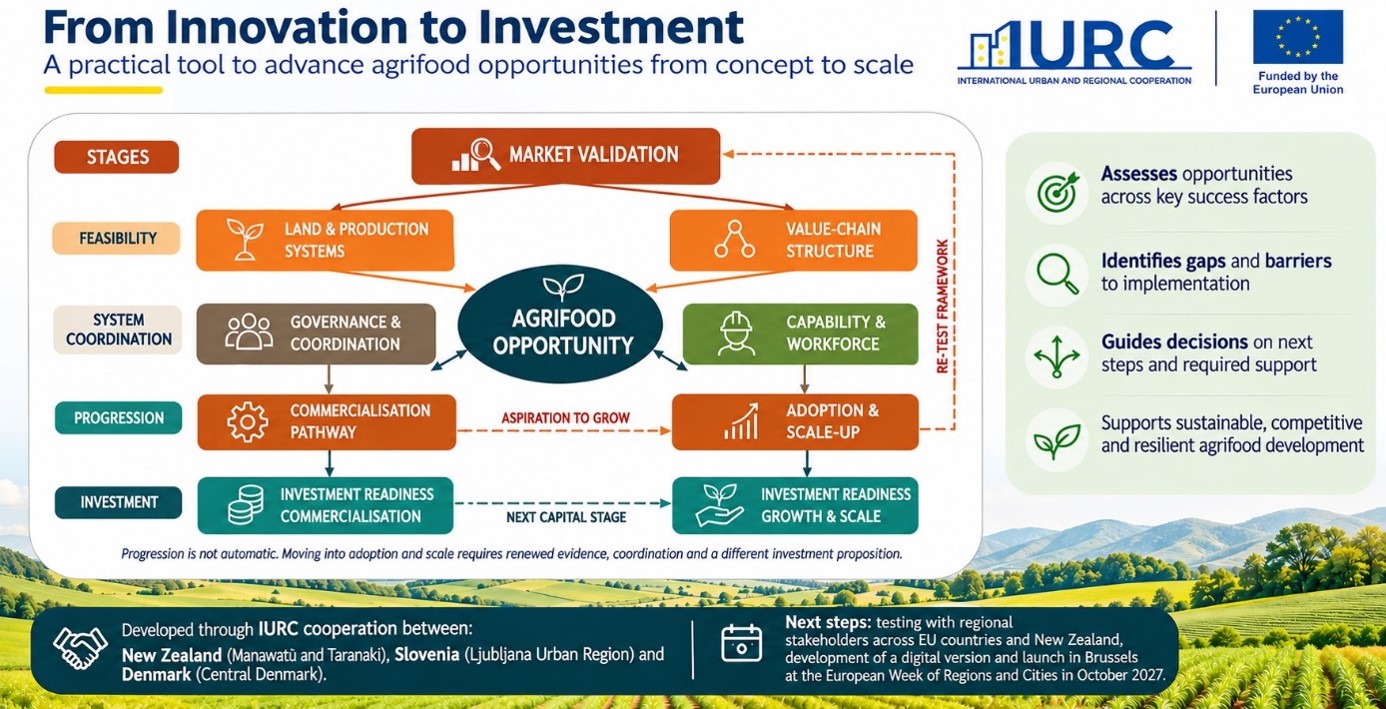
Europe and New Zealand have an abundant variety of agrifood innovation. Yet many promising ideas stall on the way to market. Picture a new agricultural product with strong technical results and clear market potential, but no processing facility, no distribution network and no one responsible for taking it forward. A new Agrifood Opportunity Assessment Framework and Validation Scorecard is designed to spot such gaps early and show where intervention matters most.
Why do promising agricultural innovations so often fail to reach the market?
Across New Zealand and Europe, researchers, farmers and entrepreneurs are developing innovative solutions for sustainable agriculture, new food systems, bio-based products and circular value chains. Yet many promising initiatives never progress beyond research, pilot activities or initial development concepts.
The challenge is often not a lack of innovation or technical feasibility. Instead, opportunities encounter barriers related to market demand, insufficient processing infrastructure, fragmented value chains, unclear ownership and governance arrangements, or limited investment readiness.
How can regions distinguish genuinely viable opportunities from promising ideas, identify what prevents their development and determine where intervention can make the greatest difference?
This question provided the starting point for the Agrifood Opportunity Assessment Framework and Validation Scorecard, developed through IURC cooperation between Manawatū and Taranaki (New Zealand), the Ljubljana Urban Region (Slovenia) and Central Denmark (Denmark).
From research to a practical decision-support tool
The framework is a concrete outcome of the partners’ Regional Cooperation Action Plan, drawing on stakeholder interviews, regional evidence and cross-regional analysis involving representatives of the agricultural sector, research institutions, public authorities, financial organisations and innovation ecosystems across New Zealand, Slovenia and Denmark.
The findings revealed a common challenge across different regional contexts: successful agrifood development depends not only on the quality of an innovation, but on the alignment of market demand, production capabilities, value-chain structures, governance, commercialisation pathways and investment conditions.
Building on these findings, the partners developed a structured methodology that assesses opportunities through five stages: market validation, feasibility, system coordination, commercial progression and investment readiness.
The accompanying Excel-based Validation Scorecard translates the framework into an operational instrument, using evidence-based criteria, scoring mechanisms and critical viability checks to identify strengths, gaps and barriers to implementation.
Rather than simply determining whether an idea has potential, the tool helps establish what is required to transform that potential into a viable and investable initiative.
For example, a new agricultural product may demonstrate strong technical feasibility and market potential but lack processing facilities, an effective distribution network or clearly defined implementation responsibilities. The assessment helps identify these constraints and guide targeted interventions before significant resources are committed.
Who can benefit — and why does it matter?
The framework is designed for regional development agencies, policymakers, farmers, producer organisations, agrifood businesses, research institutions, innovation intermediaries and investors.
Its applications range from evaluating agricultural diversification opportunities and emerging bio-based industries to developing circular value chains, supporting research commercialisation and assessing investment readiness.
For regional authorities, it provides a more transparent basis for prioritising initiatives and directing public resources. For businesses and research organisations, it helps clarify commercialisation pathways and investment requirements. For investors, it offers a structured approach to identifying opportunities with credible development potential.
Importantly, the framework shifts regional development practice from identifying promising opportunities towards systematically creating the conditions necessary for their implementation and growth.
Contributing to European policy objectives
The initiative demonstrates the added value of IURC cooperation by translating international knowledge exchange into a practical, transferable solution jointly developed by New Zealand and European partners.
It contributes to the ambitions of the EU’s Vision for Agriculture and Food, EU bioeconomy and circular economy policies, and regional innovation strategies by supporting agricultural diversification, more resilient value chains, improved resource efficiency and the commercial uptake of research and innovation.
By helping regions identify viable opportunities and address barriers to implementation, the tool can also support more effective use of public and private investment and strengthen the competitiveness and resilience of regional agrifood systems.
Although agricultural systems in New Zealand, Slovenia and Denmark differ considerably, their shared challenges demonstrate the potential for an assessment methodology that can be adapted and replicated internationally.
From regional testing to a digital tool: Brussels 2027
The next phase will focus on testing the framework and scorecard with regional stakeholders in New Zealand and across participating EU countries, applying the methodology to real agrifood opportunities and gathering feedback from farmers, businesses, researchers and regional development organisations.
The results will inform further refinement and the planned development of a digital version, making the tool more accessible, user-friendly and transferable across regional contexts.
The partnership’s ambition is to launch the digital tool at the European Week of Regions and Cities in Brussels in October 2027, presenting a tangible result of New Zealand–EU cooperation to a wider European and international audience.
Ultimately, the initiative illustrates how international regional cooperation can move beyond exchanging good practices towards co-developing practical solutions with long-term value.
By connecting innovation with market realities, investment requirements and implementation capacity, the framework aims to help regions turn agricultural potential into sustainable economic opportunities.