From a Local Pilot to a Regional E-Bike Network: Experiences from Dobrova–Polhov Gradec
Can an e-bike be a viable alternative to the car in smaller and more dispersed municipalities? Monitoring of the e-bike sharing system in the Municipality of Dobrova–Polhov Gradec within the TERRAIN project has shown that there is clear potential. E-bikes can facilitate shorter everyday journeys in particular, but wider use of the system depends not only on the bikes themselves, but also on a sufficiently extensive network of stations and safe, well-connected cycling routes.
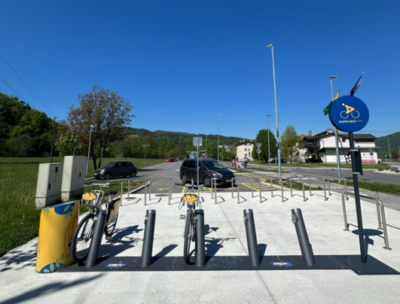
E-bike station at P+R Dobrova
The e-bike station at P+R Dobrova was established in May 2025 in cooperation with the Municipality of Dobrova–Polhov Gradec and Nomago. Within the TERRAIN – Interreg IPA ADRION project, RRA LUR monitored the use of the system and explored the potential role of e-bikes in everyday mobility in a more dispersed environment.
The evaluation combined several data sources and activities. Statistical data on system use were obtained in cooperation with Nomago, while direct user experiences were collected in cooperation with the Polhov Gradec Tourist Association, which also participated in the 3rd TERRAIN Living Lab meeting and in practical e-bike testing. Field observations on cycling connections were collected through the participatory online mapping platform of the Regional Mobility Centre of the Ljubljana Urban Region (RCM LUR). In this way, the TERRAIN project brought together actual system-use data, user experiences and location-specific observations, providing a more comprehensive picture of the opportunities and limitations of e-bike use in Dobrova–Polhov Gradec.
What do the data show?
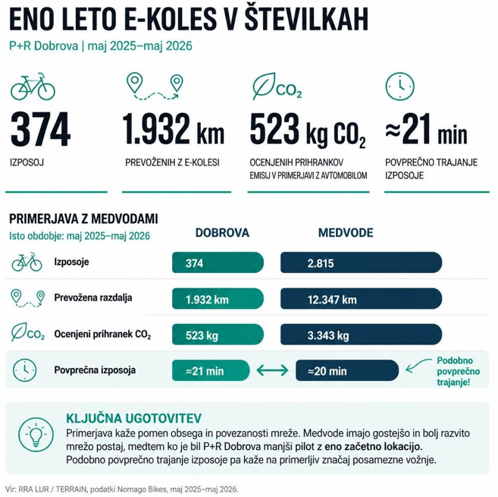
Between May 2025 and May 2026, 374 rentals were recorded in Dobrova, with users travelling a total of 1,932 kilometres. Estimated CO₂ savings during this period amounted to 523 kilograms. The average rental lasted approximately 21 minutes.
Within the TERRAIN project, we also monitored the system in comparison with the Municipality of Medvode, where the public e-bike sharing network is more extensive and users can choose between several stations. During the same period, 2,815 rentals, 12,347 kilometres travelled and an estimated 3,343 kilograms of CO₂ savings were recorded in Medvode. The average rental lasted approximately 20 minutes.
Comparing the two settings helps us understand how the scale and connectivity of the network influence system use. Although the total number of rentals in Medvode is substantially higher, the average duration of an individual rental is very similar in both systems.
A single station can provide an important starting point for introducing and testing a service. As the number of stations increases, however, so does the number of possible journey combinations. Expanding and connecting the network is therefore important for developing a system that can be used not only occasionally, but also for everyday trips.
What do users say?
Numbers tell only part of the story. We therefore also involved the Polhov Gradec Tourist Association in the monitoring activities. As part of the TERRAIN project, members of the association were provided with one-month subscriptions, allowing them to test the e-bikes on their own routes and share their direct user experience with us.
Their experience highlights both the benefits of e-bikes and two important conditions for the further development of the system: expanding the station network and providing safe cycling connections.
Polhov Gradec Tourist Association:
“We see the e-bikes at P+R Dobrova as a good alternative to the car, particularly for shorter everyday journeys. The bikes are fast and comfortable, and electric assistance makes cycling less physically demanding, which can also make them attractive to older active users. To make the system even more useful, it would be beneficial to provide more stations and bikes. Safe and well-maintained cycling connections are equally important. In our view, continued improvements to cycling connections and expansion of the network would encourage more people to use e-bikes.”
Jure Oblak, President of the Polhov Gradec Tourist Association
A good bike also needs a good route
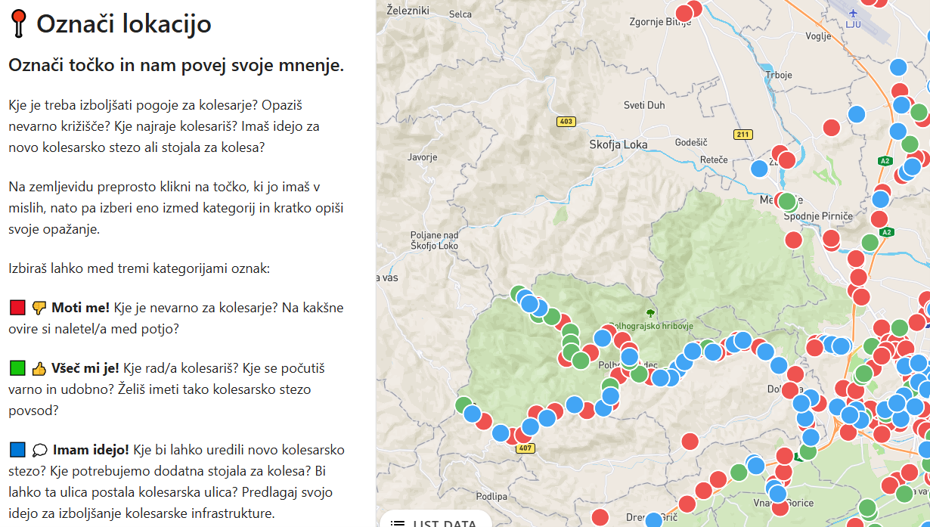
In addition to e-bike usage data and direct user feedback, we wanted to understand how cyclists experience specific routes within the municipality. Through a participatory online map, we therefore collected location-specific observations in three categories: “It bothers me”, “I like it” and “I have an idea”.
Between April and September 2026, 75 location-based entries were recorded on the map: 36 in the “It bothers me” category, 26 in “I have an idea” and 13 in “I like it”. As individual users could submit more than one entry, the results are not treated as a representative survey, but rather as location-specific observations of problems, positive experiences and opportunities for improvement.
Recurring concerns included feeling unsafe when being overtaken by motor vehicles, blind or dangerous bends, road narrowing, poor road-surface quality, and missing or discontinuous cycling infrastructure. Particular attention was drawn to gaps in cycling infrastructure on the route towards Polhov Gradec, where cyclists have to continue on the road along certain sections.
Users also pointed to the lack of e-bike stations in more remote parts of the municipality, for example towards Črni Vrh and Šentjošt. This is also an important finding for future system development: a single station enables access to an e-bike, while a denser station network and more return options substantially increase the number of journeys for which the system can be practically used.
User suggestions therefore focused mainly on extending cycling connections towards Polhov Gradec and Zalog pri Polhovem Gradcu, improving dangerous sections and bends, renewing road surfaces, and further expanding cycling infrastructure.
The map did not reveal only problems. In the “I like it” category, users particularly highlighted beautiful views, views towards Polhov Gradec, the attractive landscape and the pleasant cycling experience. This suggests that, in addition to its role in everyday mobility, e-cycling in the area also has interesting recreational and tourism potential.
The participatory map therefore revealed two sides of the same journey: an attractive environment and enjoyable cycling experience on the one hand, and concrete infrastructure and safety barriers on the other. The experience confirms a simple conclusion: a good e-bike also needs a good route. Expansion of the e-bike sharing system should therefore go hand in hand with the development of safe, high-quality and well-connected cycling routes.
From a local pilot to a regional network
An important shift is now taking place in the Ljubljana Urban Region with regard to network expansion. In September 2026, the development of the joint intermunicipal public e-bike sharing system bicikEL began.
In its first phase, the system includes eight municipalities, including Dobrova–Polhov Gradec. By the end of 2026, the system is expected to comprise 35 stations, 236 docking points and 118 e-bikes, with further expansion to 21 municipalities and 550 e-bikes planned by 2028.
A key advantage of the new system is its intermunicipal connectivity. The possibility of picking up a bike in one municipality and returning it in another increases the number of possible journeys and creates additional opportunities to connect e-bikes with public transport and P+R facilities.
This gives the local P+R Dobrova experience a broader regional dimension. More stations and better-connected systems can provide users with substantially more journey options. This was also one of the questions explored through TERRAIN: how can an individual local solution develop into a sufficiently connected network for e-bikes to become a practical option for everyday mobility?
Local experience for regional mobility planning
The experience of Dobrova–Polhov Gradec highlights three interconnected elements in the development of a public e-bike sharing system: high-quality and user-friendly bikes, a sufficiently extensive station network, and safe and connected cycling infrastructure.
Within TERRAIN, we used the local pilot to combine system-use data, field observations and direct user feedback. The experience gained also connects with the work of the Regional Mobility Centre of the Ljubljana Urban Region (RCM LUR) and the preparation of the Regional Sustainable Urban Mobility Plan of the Ljubljana Urban Region (RCPS LUR), and can contribute to broader planning of cycling and the integration of different forms of sustainable mobility across the region.
Dobrova–Polhov Gradec provided a concrete local case in this context. Bringing together partners, real-life usage data, Living Lab activities, practical e-bike testing and field observations is one of the important added values of the TERRAIN project, enabling lessons from a local pilot to inform the further development of sustainable mobility across the wider region.
As the e-bike network now expands across municipal boundaries, the next step can be observed: will a larger and better-connected network enable e-bikes to become a practical alternative to the car for an increasing number of everyday journeys?