
Zoom-in #1. Co-creating Comfort: How Ljubljana Is Reframing Building Performance Around People – EffiComfort project
European Urban Initiative innovation expert Javier Leiva, who is monitoring the EffiComfort project, in which the Regional Development Agency of the Ljubljana Urban Region is also involved, explored the social dimensions of the project through interviews with selected project partners and examined the challenges of participation and co-creation of a new energy solution.
The solution is expected to play a key role in accelerating the achievement of the Ljubljana goal of reducing energy consumption in public buildings by as much as 25% by 2030. Energy efficiency holds its greatest potential in user behaviour — even small adjustments to everyday habits can improve comfort and positively affect the health and wellbeing of building users, while also reducing energy consumption.
Zoom-in #1. Co-creating Comfort: How Ljubljana Is Reframing Building Performance Around People
Urban story, Portico Portal, Author: Javier Leiva
Efficomfort is a project that builds on Ljubljana’s strong commitment to reducing the energy consumption of its public buildings by 25% by 2030. While significant progress has been made through large-scale retrofitting, energy performance contracts and the integration of renewable energy sources, these efforts have also highlighted a key challenge: energy efficiency improvements do not automatically ensure optimal indoor comfort for occupants. Hence, this initiative is based on the idea that energy efficiency and occupant comfort should be addressed together, reframing comfort not only as a technical outcome, but as a managed service that responds to how people actually experience buildings.
Here, in this zoom-in, we explore a central dimension of the project: people. Although technical measures such as improved insulation, ventilation systems and smart energy management can significantly reduce consumption and emissions, their real effectiveness depends on how indoor environments are perceived and used by occupants in everyday life. This is where the concept of Comfort as a Service becomes essential, shifting the focus from building performance alone towards a user-centred model where comfort is defined, monitored and delivered through measurable service levels.
Our interviewees
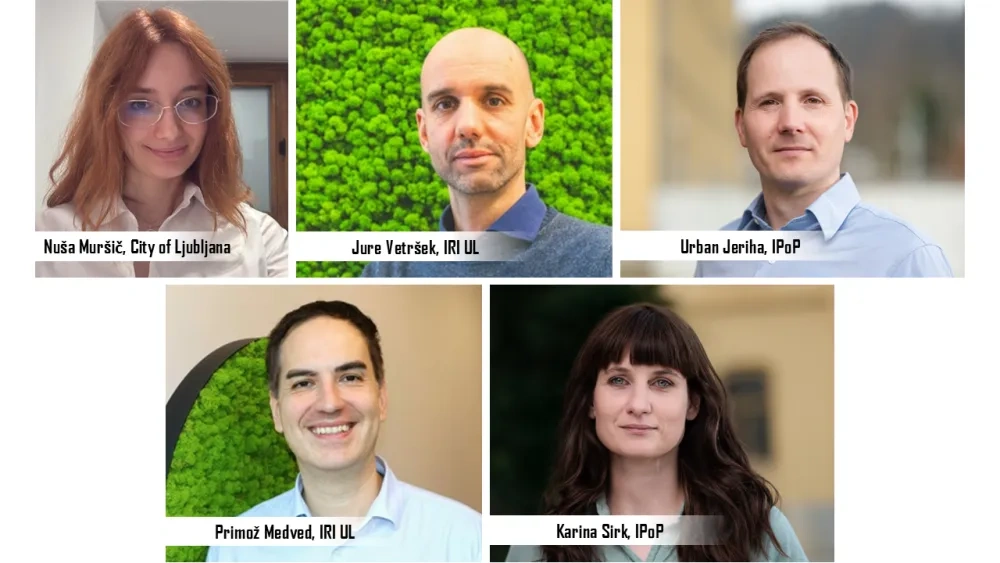
To explore how this approach is being implemented in practice, we bring together the perspectives of experts directly connected to the user-centred and participatory approach in Efficomfort. They combine municipal leadership, technical expertise and social innovation: from the City of Ljubljana, Nuša Muršič, Project Manager of Efficomfort; from the Institute for Innovation and Development of the University of Ljubljana (IRI UL), Jure Vetršek, Head of Department for Efficiency and Built Environment, and Primož Medved, Field Expert; and from the Institute for Spatial Policies (IPoP), Urban Jeriha, Director, and Karina Sirk, Expert.
The zoom-in
How did the project originate, and why were these specific sites and building types selected for implementation?
Nuša Muršič:
The project originated from Ljubljana’s strong progress in energy retrofitting, where technical efficiency improvements ensured indoor environmental quality and occupant wellbeing met legal requirements, but did not go beyond them. This revealed a ‘comfort gap’, prompting a shift from energy savings alone toward a people-centred approach framed as comfort as a service, aligned with the city’s goal of reducing energy use by 25%.
The selected pilots —two primary schools and residential housing— were chosen to represent different building typologies, ownership structures and technical baselines. This enables comparison across contexts while supporting improvements in both public infrastructure and residential quality.
Jure Vetršek:
In addition, Ljubljana’s extensive experience with ESCO-based renovations has shown that achieving guaranteed energy savings does not automatically ensure optimal building performance in real operation. A persistent performance gap often emerges between design intentions and actual use, largely influenced by occupant behaviour —a factor that traditional engineering approaches struggle to address. To tackle this challenge, the project integrates social sciences and humanities, bringing users into the control loop and explicitly considering how people interact with buildings in everyday conditions.
However, influencing behaviour requires clear and meaningful drivers. Rather than relying solely on environmental awareness or financial incentives, the project explores health and wellbeing as key motivators for behaviour change. In collaboration with the National Institute of Public Health, the initiative will test concepts such as mild thermal acclimatization training and dynamic indoor environments, encouraging occupants to accept adaptive comfort conditions. The underlying idea is that, much like lifestyle changes driven by health considerations, users may be more willing to modify their behaviour when tangible wellbeing and health benefits are evident.
Could you introduce yourselves and explain your roles in the project?
Jure Vetršek and Primož Medved:
IRI UL acts as an integrator of disciplines, bringing together technical, social and humanistic perspectives within the project. Our role is to facilitate dialogue among partners with very different backgrounds, such as technical ESCO engineers together with public health experts, and ensure a shared understanding. To support this interdisciplinary collaboration, for instance, we developed a common glossary of terms and apply our experience in cross-disciplinary problem solving. The team itself combines technical and social science expertise, enabling us to bridge these different approaches.
We are also responsible for the evaluation architecture, methodological design, data integration, analysis and quality assurance. The team has already delivered a set of core deliverables which are conceived as living documents, that means that they will be updated regularly throughout the project to reflect ongoing learning and implementation progress.
Urban Jeriha and Karina Sirk:
IPOP operates at the intersection of research, consultancy and NGO practice, with a strong focus on participatory processes. While indoor environmental quality is a relatively new topic for us, we apply our expertise in stakeholder engagement and co-creation to this field. Our role is to connect the scientific and technical work with end users, ensuring that their perspectives and experiences inform the development of the Comfort as a Service concept.
Within the project, IPOP leads the participatory approach and supports communication activities, linking partners and user groups throughout implementation. We contribute to the co-creation of the service model, help test different scenarios, and gather feedback from participants. In this way, we aim to engage diverse publics and ensure that participation meaningfully informs both the design and delivery of the proposed solutions.
The project emphasises a people-centred approach. How is this translated into practice?
Nuša Muršič:
The key idea is to move from treating occupants as passive consumers to engaging them as active participants. The project aims to provide users with the knowledge and tools to understand their own comfort, including through thermal acclimatisation training, enabling them to adapt their behaviour. This behavioural dimension is expected to support both energy savings and improved health and wellbeing.
At the same time, smart energy systems and sensors collect real-time indoor environmental data, allowing technical solutions to respond dynamically to occupants’ presence and comfort levels rather than relying on rigid schedules. This is complemented by co-design and participatory activities —including surveys, focus groups and workshops— ensuring that the comfort as a service concept reflects user experiences and is shaped together with them.
What strategies and methodologies are being used to engage occupants and stakeholders throughout the design and implementation phases?
Jure Vetršek:
At the strategic level, we apply a people-centred development approach structured in several steps. First, we identify who we are solving the problem for, segmenting target groups such as residents, pupils, teachers and technical staff. We then engage them using mixed methods, including ethnographic-inspired observation to understand behaviours, motivations and real-life practices. This is complemented by technical monitoring, allowing us to compare measured data with observed behaviour and vice versa, creating iterative feedback loops that inform both evaluation and design.
Primož Medved:
Our strategy also relies on pilot-specific formats, meaning that schools and residential settings are addressed differently and each target group is approached with tailored methods. Stakeholders are involved early and repeatedly, before implementation begins, and participation is directly linked to evidence generation. The insights gathered inform monitoring logic, communication strategies and implementation sequencing. In practice, we combine surveys, interviews, focus groups, workshops, observation and feedback loops, all integrated with the technical monitoring systems.
Karina Sirk:
These methods are designed to work together in an iterative way, where each activity informs the others and helps build a comprehensive understanding of user needs. We combine qualitative and quantitative approaches at different levels, always adapting them to the specific characteristics of each target group. Rather than treating participants as a single audience, engagement activities are tailored to pupils, teachers, tenants and other stakeholders, ensuring that diverse perspectives are captured and reflected in the project.
What challenges do you anticipate in engaging different user groups, and how do you plan to address heterogeneity, participation and coordination across stakeholders?
Karina Sirk:
One of the main challenges relates to the diversity of tenants, including different cultural backgrounds, family structures and language abilities. Initial engagement showed that participation will largely depend on motivation, as most activities take place in residents’ private time. For this reason, early trust-building was essential. Meeting residents in person during the contract-signing phase helped establish a positive first contact, introduce the project clearly and open a dialogue about their everyday comfort practices. The main anticipated risk is limited participation in planned activities, although the initial response suggests strong interest and willingness to engage.
In schools, participation is more structured, but other challenges may emerge, particularly regarding the implementation of temperature training. Current conditions are already close to comfort limits, so how users will respond to dynamic comfort strategies remains to be tested. Initial focus groups, interviews and surveys with pupils and teachers have provided useful baseline insights, and engagement will continue as the methodology is further developed.
Urban Jeriha:
Some challenges were already addressed during the design of the initial surveys. Not all age groups can respond to standardised questionnaires, so classes were selected accordingly to ensure meaningful participation. This helped avoid methodological issues early on and ensured that data collection tools match the capacities of the target groups.
Primož Medved:
Another challenge relates to heterogeneity across user groups, including pupils, teachers, tenants and facility managers, all of whom have different expectations and capabilities. To address this, we apply a differentiated approach rather than a one-size-fits-all model. For example, surveys share a common structure but are adapted to each group, including variations in language, complexity and response scales. This allows us to maintain comparability while ensuring accessibility and relevance.
Jure Vetršek:
Further challenge lies in the interdisciplinary nature of the project. Integrating technical, social and health perspectives requires time and coordination, particularly when translating complex concepts into practical tools for different audiences, such as young pupils. Aligning expectations among research organisations, public authorities and private partners also requires continuous dialogue. These challenges are anticipated and managed through regular coordination and a structured risk management approach, which is updated throughout the project.
How do you envision the balance between technical solutions and behavioural participation, and how will user habits and preferences be integrated into the proposed solutions?
Jure Vetršek:
In schools, this balance is already being implemented during the design phase. The ventilation and monitoring systems were not developed only by engineers, but through repeated on-site visits of interdisciplinary design team and meetings with principal, teachers and technical staff. Their daily practices, such as occupancy patterns, use of blinds or classroom routines, were considered from the beginning. This allows technical solutions to reflect real conditions rather than purely theoretical assumptions. Sensors, system configuration and integration into the building management system are therefore defined in close dialogue with users and based on actual performance and project needs.
For residential buildings, this process is just starting, as tenants are only now moving in and baseline data still needs to be established. Continuous engagement will be essential, together with careful handling of privacy and data protection aspects, since monitoring takes place in private homes. Building trust and maintaining regular contact with residents will be key to aligning behavioural patterns with technical targets. The involvement of trusted partners, such as the National Institute of Public Health, also helps support acceptance, particularly as the project emphasises health and wellbeing benefits.
Karina Sirk:
From the engagement perspective, the initial contact with residents has been very positive, and maintaining that trust is essential. Since participation takes place in their private time and monitoring involves personal spaces, it is important to show respect for their contribution and acknowledge the value of their time. This includes transparent communication about the purpose of monitoring, as well as ensuring participants feel their involvement is meaningful and appreciated.
We are also considering small forms of compensation to support participation, such as providing tickets to public facilities for the first rounds of interviews and surveys. These are not direct financial incentives but aim to recognise participants’ effort and encourage continued engagement, particularly for households with limited resources. Beyond material incentives, the intention is also to make participants feel part of a shared initiative, reinforcing trust and supporting the connection between behavioural engagement and technical implementation.
How is this initiative perceived by the city, stakeholders and the wider ecosystem?
Nuša Muršič:
The project is seen as a valuable contribution to Ljubljana’s long-term vision, particularly in supporting the transition towards a sustainable, green and smart city while maintaining a high quality of life. By combining energy efficiency, health, comfort and citizen engagement, the initiative aligns closely with the city’s strategic objectives and reinforces its broader sustainability agenda. In this sense, the project is perceived as a practical step towards achieving these ambitions and integrating different policy priorities into a single approach.
More broadly, there is strong support within the local ecosystem for initiatives that reduce energy costs while improving wellbeing and indoor comfort. The project also connects with wider European ambitions, such as climate-neutral and smart city initiatives, which helps strengthen its relevance and visibility. As Ljubljana places strong emphasis on its image as a green, resilient capital, this type of people-centred innovation is well aligned with the city’s positioning and is therefore positively received by stakeholders.
From pilot implementation to a people-centred urban model
As Nuša Muršič describes, the project is now moving from set-up into active implementation. In residential buildings, tenants have already moved into their apartments and initial participatory activities have started. In schools, engagement work is also underway. At the same time, key technical components are already in place, with sensors installed in both schools and housing units, making the project physically visible and enabling baseline data collection.
The next phase follows a clearly defined timeline. The design of heating and ventilation systems is currently being finalised, with installation planned over the summer period to avoid disruption to school activities. This sequencing is intended to ensure that technical deployment and participatory processes progress in parallel, maintaining alignment between social and technical dimensions throughout implementation.
Looking ahead, the project aims to gradually consolidate a Comfort as a Service approach, where indoor environments are managed not only through technical efficiency but also through user behaviour, comfort and wellbeing. In line with Ljubljana’s Vision 2045 and wider sustainability goals, the initiative is positioned as a step towards a more integrated and people-centred urban strategy.
Visit Portico Portal for the original content and more: https://portico.urban-initiative.eu/urban-stories/european-urban-initiative/zoom-1-co-creating-comfort-how-ljubljana-reframing-building-performance-around-people-9047
The EffiComfort is supported by European Urban Initiative (EUI) and is cofinanced by the European Union.

