
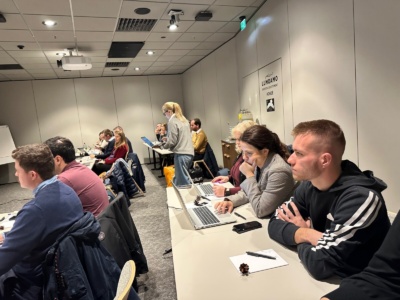
 “Tourism as a Whole” represents the vision of the TAAS – Tourism as a Service project, which brings together partners from eight European regions with the aim of contributing to the European smart specialisation strategy. The project focuses on transforming tourism through accelerated digitalisation and the improvement of policy instruments that support smart and sustainable development. This time, project partners and stakeholders discussed good practices, digital tools, and innovative planning and management of tourism based on sustainability principles in Stockholm, the capital of Sweden, and in the city of Tampere in Finland.
The Regional Development Agency of the Ljubljana Urban Region (RRA LUR) invited Anja Stare Zornada, Head of Tourism Programmes at the Sotočje Medvode Public Institution, and Jure Oblak, President of the Polhov Gradec Tourist Association, to the November partner meeting. Both stakeholder representatives are involved in the transformation and development of the Polhograjski dolomiti area as a tourist destination within the Regional Development Programme for the 2021–2027 financial perspective.
Modern challenges in tourism require a shift from spontaneous development to thoughtful and data-driven management of tourist destinations. Smart management and planning of tourism are becoming the foundation of sustainable tourism development, as they rely on the use of digital tools, stakeholder cooperation, and long-term thinking that considers the carrying capacity of the area, the needs of local communities, and the quality of the visitor experience. Instead of uncontrolled growth, destinations increasingly use data on visitor numbers, mobility, and behaviour, which enables better strategic decision-making. Various stakeholders – from local communities and tourism providers to municipalities and regions – are actively involved in management, allowing for greater consensus and adaptation of development to the needs of the area and its people. Such planned tourism brings benefits to the local environment while enhancing the experience of visitors.
During the study visit, participants in Stockholm learned about a good practice example based on cooperation, trust, and a vision that goes beyond competition. In the Museum Park on the island of Djurgården, visitors can explore numerous cultural attractions and museums – including the Vasa Museum, Skansen, the ABBA Museum, the Technical Museum (Tekniska), and the Gröna Lund amusement park. Although these are independent institutions, their goal is not to create a competitive environment but one of mutual connection. Under the joint environmental and tourism brand Royal Djurgården, governmental and non-governmental organisations of the Museum Park cooperate by exchanging data, implementing new tourism products, presenting a unified media image, and introducing various other tourism- and sustainability-related solutions to build a narrative of collaboration. The aim is to extend the duration of visits and attract visitors to the park outside the main tourist season. In the summer months, more than 4,000 people work together directly to create a coordinated rhythm among the different partners within the Royal Djurgården community.
Finland is known as a tourist destination primarily for its exceptional natural landscapes, comprising 40 national parks. The city of Tampere is recognised as a destination consistently committed to sustainable development. As in Stockholm, cultural, tourism, sports, and administrative organisations in Tampere cooperate formally and informally with the aim of developing tourism that is sustainability-oriented rather than focused on gaining competitive advantages for individual organisations. They strive to offer visitors a Sustainable Travel experience that does not provoke discomfort or guilt associated with the desire to explore the world. Organisations in Finland that operate according to sustainable development principles confirm this with verified certificates. Their cooperation is based on creating conditions that enable the visitor to travel carefree and in an environmentally friendly way while motivating them to make sustainable choices.
The study visit, which consistently featured presentations of proven and successful sustainability solutions, offered Slovenian TAAS project stakeholders – the Head of Tourism Programmes at the Sotočje Medvode Public Institution and the President of the Polhov Gradec Tourist Association – numerous opportunities to obtain first-hand information on sustainable tourism and opened space for networking. Participants learned about advanced practices in sustainable mobility, smart city solutions, green infrastructure, and the digital inclusion of local communities in tourism planning.
Based on the exchange of experiences, an initiative emerged to prepare an online seminar for all TAAS project stakeholders involved in the transformation and development of the Polhograjski dolomiti area as a sustainable tourist destination, featuring a presentation of good practices in the management of cycling and hiking trails in Finland. Such a presentation could significantly contribute to identifying high-quality solutions that could be transferred to the local environment.
When preparing the tourism strategy of the Municipality of Medvode, it is advisable to take into account examples of successfully functioning destinations, among which the Irish region of Donegal stands out. In recent years, Donegal has faced challenges very similar to those in the Municipality of Medvode and has responded effectively. A comparison of the two areas reveals several common points. The first is the overuse of certain locations, which results in overloaded infrastructure, poorer visitor experiences, and negative impacts on the natural environment and local residents. The second is the challenge of sustainable mobility, as access to natural attractions and rural areas often depends on private vehicles, increasing pressure on space. The third shared aspect is the need for modern digital and information infrastructure that enables visitors to better plan their visit, navigate more easily, and use the area more responsibly. A key element highlighted by the Donegal example is the engagement and activation of the local population – a shift from a passive role to active co-creation of the tourism offer and destination management.
Donegal’s experience confirms that with proper community involvement, efficient mobility organisation, and well-designed information support, it is possible to significantly improve the quality of life for local residents while enhancing the visitor experience. Therefore, the findings from the study visit and the practices presented provide a valuable foundation for the continued development of Medvode, Polhov Gradec, and the Polhograjski dolomiti as sustainably oriented tourist destinations.